Developer documentation ‹ 6. The core binaries › 8. The guest-side binaries
7. The switching binaries
Everything that touches a packet lives in the namespace cloonix_<net>.
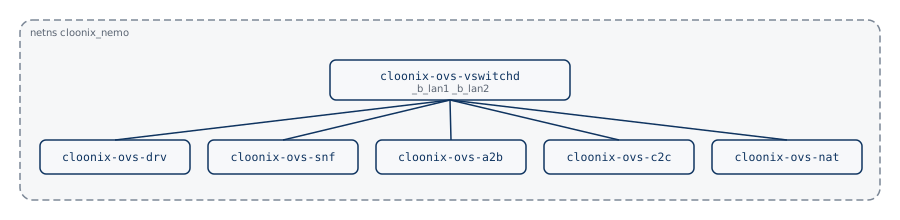
7.1. The openvswitch four
cloonsrc/ovs: a cmd, a patched_create and ovs.patch around the vendored openvswitch; the patch lets several instances run side by side under cloonix's names, and cmd skips the probe of conntrack timeout policies, whose dummy policy the kernel logs at every start:
cloonix-ovsdb-server  cloonix-ovsdb-tool    the configuration database
cloonix-ovs-vswitchd                        the switch
cloonix-ovs-vsctl                           the client, unchanged but the name
cloonix-ovs-drv is cloonix's own wrapper, one per net: creates the namespace, starts the database and the switch inside it, and runs every change of the switch the main server asks for, as text on a unix socket: lans, ports, mirrors, taps, phy.
ovs_popen.c runs each ovs-vsctl and ip command of the drv in a forked worker and reads back what it printed from ovs_cmd_out_<pid>.txt of the ovs directory, one file per process: the drv itself runs the ip commands that move interfaces into the namespace, its netns child every ovs-vsctl, and the two run at the same time. A snf mirror is taken out of the bridge of its lan first, out of the other bridges only when a row is left.
7.2. The satellites
All started by suid-power, none setuid:
cloonix-ovs-drv    one per net: the switch itself, above; netns.c, ovs_cmd.c, action.c
cloonix-ovs-snf    one per sniffed interface: pcap_record.c writes, tun_tap.c reads the
                   mirror, inotify_trigger.c wakes webshark without polling
cloonix-ovs-a2b    the impairment: circle.c the delay ring, replace.c loss, sched.c the
                   rate, the loss, the delay and the jitter of each direction
cloonix-ovs-c2c    a lan carried over udp: udp.c, rxtx.c, packet_arp_mangle.c
cloonix-ovs-nat    the nat item: machine.c per guest, passt_shuttle.c to the host side
The four other than drv share ctrl_link.c of lib_io_clownix: the listening unix socket the main server connects to, the one live connection (a second one replaces the first, the listener is kept), the watchdog and the stop. The main server sends a pid_req about every second (a2b, nat and snf once per second, c2c on every pass of its heartbeat, 0.5 or 1.5 s); the first must arrive within 5 s, then one per 20 s, or the satellite stops itself with one warning line, both deadlines measured on the monotonic clock with the credit of stall_detect.h for the time the satellite itself was not running. The 20 s are the same silence proxymous gives the switch: a main server late by a few seconds is a host held by something else, a broadcast storm in a guest for one, and a satellite stopping on it cuts a link that was sound; a c2c cut that way is rebuilt by its master, minutes later. Every stop, watchdog, closed connection or kil_req, is the same ctrl_link_stop: the paths the satellite registered are unlinked, its tap children killed, exit 0. A path found at start means the previous holder was killed rather than stopped; it is erased with a warning. The nat keeps a second watchdog of the same period on its proxymous leg. The tap child of a2b, c2c and nat shares tap_child_from_parent and tap_child_to_parent of intf_flags.c; only the tap write policy differs and stays in each tun_tap.c. The a2b and nat parents read the pipe a batch at a time, at most SEQTAP_PIPE_BATCH (32) frames per event while fct_seqtap_pipe_more finds the next header there: a turn of the loop costs more than a frame, and one frame per turn let a tcp burst from a guest overflow the 1 MB pipe of the nat. The c2c parent reads one frame per turn: its next hop, the unix datagram queue of proxymous, holds ten, and a batch overflowed it.
cloonix-passt is not cloonix's code, cloonsrc/passt a cmd around the vendored passt; it runs on the host, which is why the shuttle exists. The nat item and the nat code inside proxymous are two things: the first serves the guests, the second cloonix's own traffic.
Developer documentation ‹ 6. The core binaries › 8. The guest-side binaries